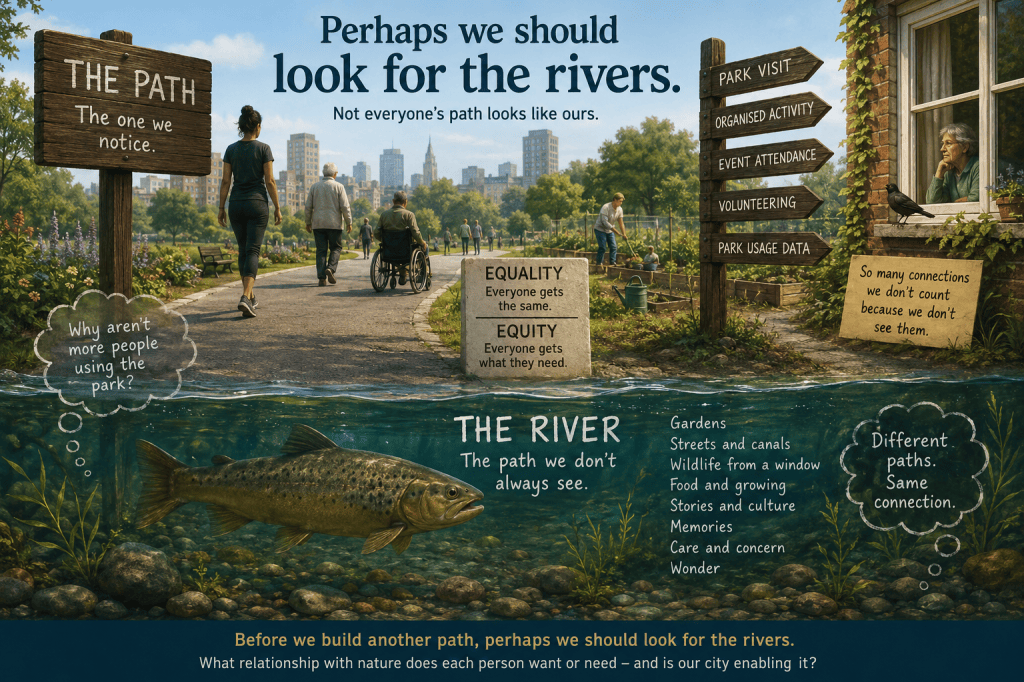
I’ve been thinking about why people don’t use parks.
It’s one of those questions we ask quite often. We know that spending time in nature can be good for our health and wellbeing. We know parks provide places to walk, play, meet, exercise, notice wildlife or simply sit for a while.
So why doesn’t everyone use them?
Strangely, one of my favourite films – When Harry Met Sally, gave me somewhere to start. At one point Harry leaves Sally a message after she hasn’t returned his calls. He offers two possible explanations: either A. she doesn’t want to speak to him, or B. she desperately wants to speak to him but is trapped under something heavy.
Perhaps we need to ask something similar about parks. Is it:
A. I don’t want to use the park.
Or:
B. I would like to use the park, but something is stopping me.
Those are two very different things.
For B, the “something heavy” might be poor health, disability, fear, lack of time, caring responsibilities, nowhere to sit, no toilet, an inaccessible entrance, previous bad experiences, not having anyone to go with, or simply a feeling that this place isn’t really for people like me.
Those are barriers. And if we can understand them, perhaps some of them can be removed. But A matters too. What if somebody simply doesn’t want to go to the park Do we need to change their mind? Perhaps not.
And, as it happens, Sally turns out to offer another possibility: C. I don’t really know what I want yet.
Perhaps someone has never had the experience that might help them discover what a park or nature more widely could mean to them. Nobody has shown them the blackberries, invited them on the walk, helped them notice the kingfisher or made that first encounter feel as though it belonged to them.
And then there is another possibility:
D. I already have a relationship with nature. You’re just not looking in the right place.
Because accessing nature and visiting a park are not the same thing. People experience nature in gardens, streets, canals, allotments, cemeteries, school grounds, food, weather, memories, stories and through their windows. Someone can care passionately about elephants in Africa without ever having seen one in the wild or travelled to Africa. Distance doesn’t make that care imaginary.
Equally, someone can walk through a park every day and feel very little connection with the nature around them. Perhaps we have been looking for a straight line:
Access → Visit → Participate → Connect → Value → Care
It’s wonderfully neat.
It’s also not particularly human.
People arrive at care, connection and action from all sorts of directions. One person begins with football. Another with gardening. Someone else with birds, childhood memories, climate change, photography, food, their dog, a television programme or the tree outside their bedroom window. There is no single path. And that brings me to that phrase people use “…… like a fish needs a bicycle.”
The humour comes from offering something as a necessity to a creature for whom it makes absolutely no sense. Sometimes I wonder whether, with the very best of intentions, we do something similar.
There’s a park ten minutes away.
We’ve organised an activity.
It’s free.
Nature is good for you.
Why aren’t you coming?
Perhaps sometimes we are trying to give a fish a bicycle. That doesn’t mean the fish needs nothing. It means we haven’t understood what the fish needs. And that takes us back to the heart of Birmingham’s City of Nature ambition: Fair.
Fair isn’t equality. It is equity. Equality might say, Everyone gets the same park, the same activity, the same opportunity. Equity asks, What does each person need?
And the word everyone matters here – everyone doesn’t mean an imaginary average population. It means each and every person. Each with different experiences, abilities, cultures, interests, fears, responsibilities, memories and desires.
Of course, no city can create a completely bespoke system for every individual. Schools need timetables. Health services need pathways. Councils need processes. Parks need management plans. Systems need some standardisation simply to function.
The danger comes when we forget that the system is a tool for managing complexity and start expecting people to become less complex so that they fit it. Perhaps that is also why consultation can sometimes be so frustrating. We ask people what they want. They tell us. And then, without necessarily meaning to, we translate what they have told us into something our existing system already understands how to provide.
Someone says, I’d like somewhere comfortable to sit outside with my neighbours.
We hear: park facilities.
Someone says, I want my children to be able to play outside.
We hear: playground provision.
Someone says, I’m lonely.
We hear: organised social activity.
None of those responses is necessarily wrong.
But somewhere in the translation we can lose the person. And perhaps there is an even bigger problem. Maybe there are already far more pathways than we realise.
We simply don’t recognise them as paths.
Imagine we are assessing access. We look for the path. We find the tarmac path. We can measure it. Its width. Its condition. Its gradient. Where it starts and finishes. How many people use it. Excellent. Except – what if there’s a fish beside us. And the fish isn’t using our path. We could improve the signage. Run an engagement campaign. Organise a fish only group and invest in a beautifully resurfaced accessible route.
Eventually we will write:
“Despite significant investment, uptake remains disappointingly low.”
Because we never noticed the obvious. The river is the fish’s path to the park but we weren’t looking at the river.
What if we’re doing versions of that with people? If we define engagement as attending an organised activity, we will find attendees. If we define connection with nature as visiting a park, we will find park visitors.
If we define volunteering as signing up for a volunteer session, we will find registered volunteers.
And everyone else risks becoming “hard to reach”, “inactive”, “disengaged” or “non-users”.
But perhaps some of them aren’t disengaged at all. Perhaps we’re counting feet on tarmac but not seeing:
The woman watching blackbirds from her kitchen window.
The teenager who takes the canal route home.
The child fascinated by dinosaurs.
The gardener saving seeds their grandparents grew.
The person donating money to protect animals thousands of miles away.
The commuter who loves watching the seasons change through the bus window.
Those might all be different paths or perhaps they are rivers or streams – different environments
And that changes the question. Instead of asking:
How do we get more people onto the path we have created?
Perhaps we should ask:
What relationship with nature does each person want or need and is our city enabling it?
And before we build another high quality tarmac path, perhaps we should spend a little more time looking for the rivers.

