Green Pages is a space for exploring some of the quieter reflections sitting underneath Birmingham’s City of Nature journey.
Part nature writing, part systems thinking, these pieces often begin with ordinary moments:
a walk,
a conversation,
a bridge,
a memory,
mud on a child’s hands.
From there, they gently wander into bigger questions about belonging, wellbeing, nature connection, memory and what it means to remain connected to the living world in modern urban life.
This reflection began with a surprisingly simple question:
Can adults ever really see “just mud” again?
I found myself thinking about this after hearing the line in Men in Black about “never being able to just look at the stars anymore.” Once we understand something deeply, can we ever see it simply again.
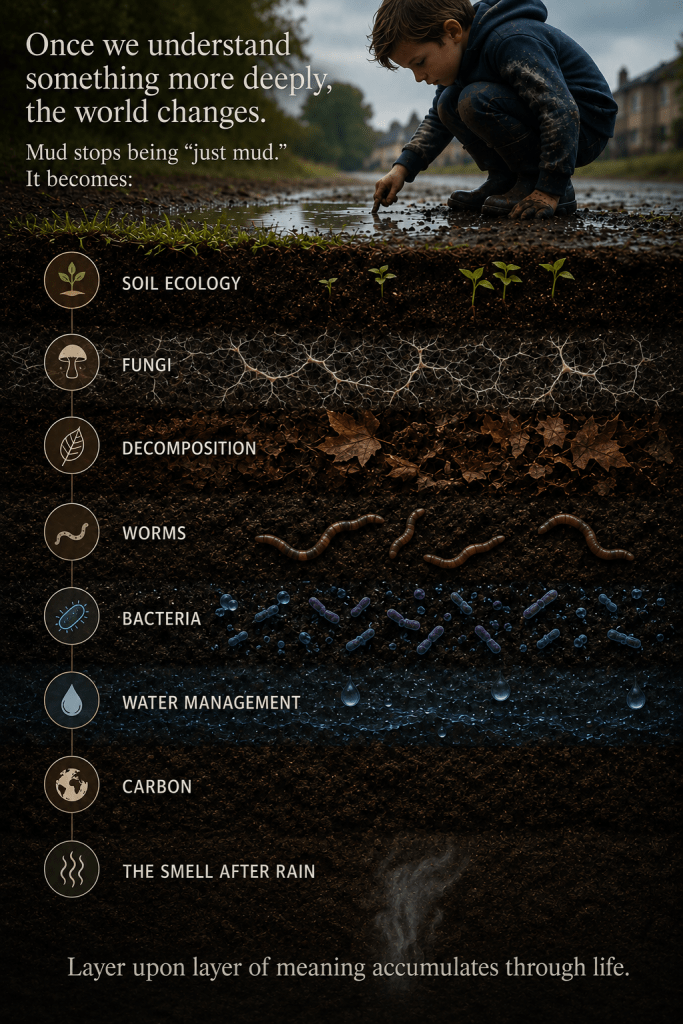
As we learn more and more over the years mud stops being “just mud” and becomes:
soil ecology,
fungi,
decomposition,
carbon,
flood management,
bacteria,
worms,
the smell of soil after rain becomes – petrichor
Layer upon layer of meaning accumulates through life. Perhaps that is true of many things. Canals become infrastructure and history. Trees become biodiversity and climate resilience. Water becomes systems, sustainability and risk.
And yet children often encounter these things differently. Mud is not part of “environmental infrastructure.”
It is cold.
Wet.
Messy.
Funny.
Something to jump in, dig through and explore.
The immediate experience comes first.
Maybe part of helping children connect with nature is not only teaching them the facts about the environment that we have learned. Perhaps it is also about protecting that direct relationship with the living world before too many layers settle over it.
Not because knowledge is wrong. Knowledge matters deeply. But perhaps wisdom is learning how to hold both things at once, understanding complexity while still being able to feel wonder. To know the science of soil and still delight in muddy puddles. To understand biodiversity loss and still be excited by muddy pawprints.
Because perhaps a child is not simply our “younger self.” Perhaps the child is actually the oldest layer of consciousness we still carry.
The first noticer, the first self to experience rain, mud, trees, fear, joy, light and belonging without explanation. Everything else came afterwards. Responsibilities and assigned roles becoming professional identities and knowledge creating layer upon layer of accumulated self.
But underneath all of that, something older remains. The original consciousness that first encountered the world directly. The source code of being human. And perhaps that is why nature connection matters so profoundly. Because when children play in mud, follow insects along a twig, climb trees, stare into water or lie in long grass watching clouds move overhead, they may not simply be “learning about nature.” They may be forming the deepest layer of consciousness they will carry for the rest of their lives.
The baseline from which future belonging, curiosity, empathy and wonder will grow. Perhaps decades later, after careers, responsibilities, losses, systems and accumulated selves have gathered around them, something unexpectedly cuts through: the smell after rain, sticks floating on water beneath a bridge, summer air through an open window, bees bumbling into foxgloves beside a path, distant birdsong at dusk.
And for a moment, the intervening layers become thinner. Not gone but for a while at least – translucent.
And something ancient inside them quietly remembers the time before productivity, before identity, before performance, before explanation, when they belonged to the living world.
Perhaps that is the real importance of helping children connect with nature. Not simply because nature needs protecting. Not because children need to accumulate knowledge. But because somewhere in the future, the latest version of that child may desperately need to remember who they were before the layers settled over them.

