I recently saw a short video that has stayed with me.
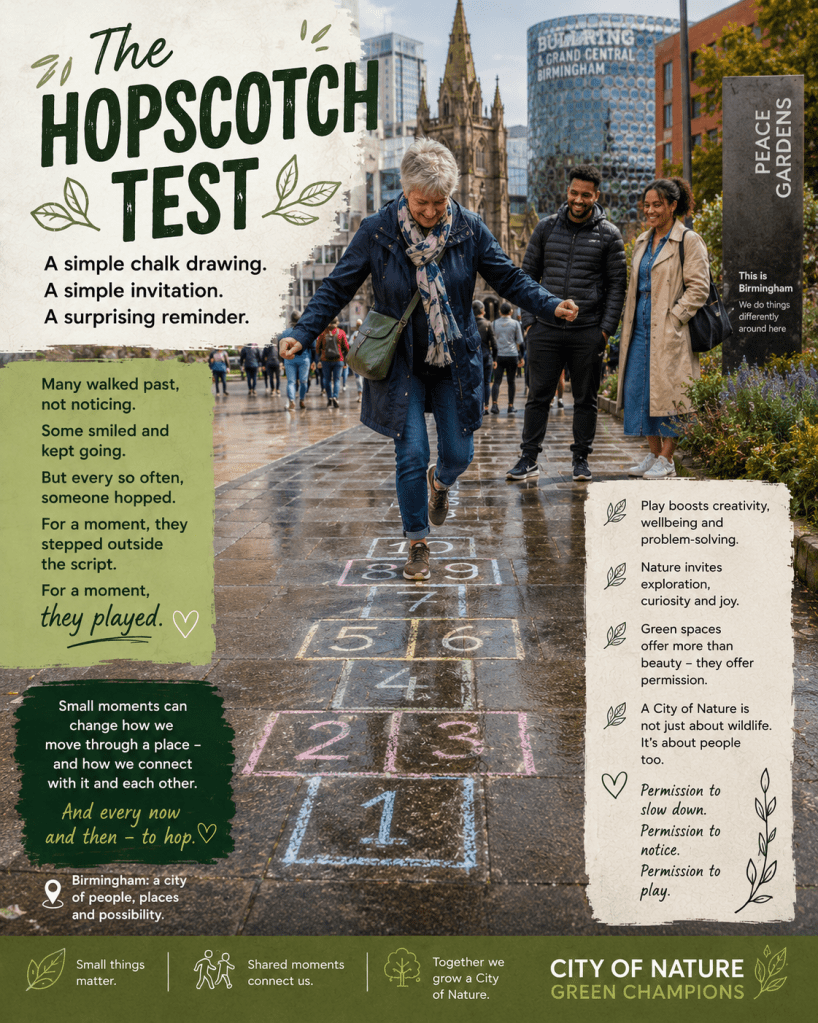
Someone had drawn a simple hopscotch grid in chalk on a pavement. Nothing complicated. Just a few numbered squares. The camera then recorded the reactions of adults walking past. Many people didn’t notice it at all. Some were looking at their phones. Some stepped around it unsure what it was, others passed without a glance and some saw it and smiled before continuing on their way.
But then something interesting happened. Every so often, somebody hopped. Perhaps only for a second sometimes only a couple of squares. Sometimes alone but often with a friend. Almost always laughing.
And it made me wonder: What exactly were they responding to?
The chalk?
The game?
A memory?
Or an invitation?
As adults, we spend much of our lives moving with purpose. From meeting to meeting.
Task to task. Notification to notification. We become very good at getting to the next place often without hestiation.
Less often do we allow ourselves to simply experience where we already are. Yet many of the things we value about nature work in a remarkably similar way to that hopscotch grid.
A winding path invites exploration.
A fallen tree invites balancing.
A stream invites curiosity.
A meadow invites wandering.
A bench invites pause.
None of these things demand our attention. They simply offer it. Whether we accept the invitation is up to us.
Perhaps that is one reason why parks and green spaces matter. Not only because they support biodiversity, improve air quality, reduce flooding, store carbon, or contribute to physical and mental health. They do all of those things. But they also provide something harder to measure.
Permission – Permission to slow down, to notice, to wonder and to play.
Children rarely need encouragement to do this. They instinctively turn spaces into adventures. A patch of grass becomes a kingdom, a stick becomes a sword, wand or fishing rod and a puddle becomes an irresistible challenge.
Adults often need reminding. Not because we have lost the ability. Because we have become distracted from it. Perhaps that is why the adults who hopped along the chalk squares were smiling. For a moment they stepped outside the script and were not simply passing through a space they were participating in it.
The hopscotch grid disappeared eventually. Rain would have washed it away. But for a few hours it changed how people moved through that place. It nudged them from observer to participant. And perhaps that is one of the quiet lessons hidden within a City of Nature. The goal is not simply to create greener spaces. It is to create places that invite people back into relationship with the world around them.
Places that encourage us to notice, to connect, to explore and every now and then -to hop.

