The way Birmingham City Council manages it’s parks, green and blue spaces and even some of its grey spaces has changed in line with Birmingham’s City of Nature Plan which you can read here: https://www.birmingham.gov.uk/…/our_future_nature_city…
It is an ambitious 25-year plan for the whole city, but it starts in its heart with six wards most in need of change, we call these the priority Red Wards:
• Bordesley and Highgate
• Balsall Heath West
• Castle Vale
• Gravelly Hill
• Nechells
• Pype Hayes
A key part of the delivery of the plan are people who are already championing the good design, care and use of their natural environment and those who want to get started doing this. We call them Green Champions. They may be community workers, teachers, council officers, councillors, police officers, business owners, Friends Group leaders, students, volunteers, or anyone else that could help form a network across their neighbourhood or ward.
Over recent years the number of Birmingham City Council officers caring for Birmingham’s natural environment have decreased due to budget pressures on local government. The council is very aware of and grateful for all the people who are already working as “Green Champions” across the city, without them the city would be far worse off. But it is in the Red Ward areas where nature is most under pressure but residents are still in need of the benefits that nature offers where change is happening first.
What we know is that if we work together things happen better and faster and that’s why we are reaching out to you with a very simple ask. We want to connect you to the Birmingham Park Ranger Service who are delivering the Wild at Heart Project in the red wards in the heart of the City: https://www.birmingham.gov.uk/…/our_future_nature…/4
We already have some amazing networks of people working across the whole city, like the City of Nature Alliance of organisations, Birmingham Open Spaces Forum and Friends Groups, Birmingham and Black Country Wildlife Trust Members, Litter Picking Groups, Neighbourhood Forums etc. If you are already part of one of these groups that’s great, please still join the Green Champion Network to receive specific information directly from the Rangers providing opportunities to get advice, have your voice heard and, if you would like to, meet other Green Champions in your area.
There is no commitment further than sending your details to the Birmingham Ranger Service Healthy Parks Programme so that your local Rangers can contact you and start a conversation to make sure you get regular updates from them (even if you already know them) and help them to help you improve your local environment and connect people to nature.
Please share this with anyone who might also want to get involved in the Rangers Healthy Parks Programme. Thank you.
You may have been following my Friendship Bench Chat project as I take time to sit down on a bench in a park and chat to friends and colleagues about benches, parks, nature and most importantly give them an opportunity to chat about themselves and if they are OK. We know that a connection with nature brings us increased wellbeing. Just looking at images of a healthy natural environment can help us to relax, children often use the word calm when we ask them how they feel when they are outdoors in nature. But in some of our urban environments helping children to connect with nature can take a lot of work. Our green spaces need to be well managed and we often need connectors, people who help make the connections, for many of the city’s children to be able to benefit from the joy that our parks can bring.
In this bench chat I talk to one of those connectors – Helen Harvey who until recently worked for Birmingham Open Spaces Forum and has left a legacy of nature connection for one school right next to Garrison Lane Park.
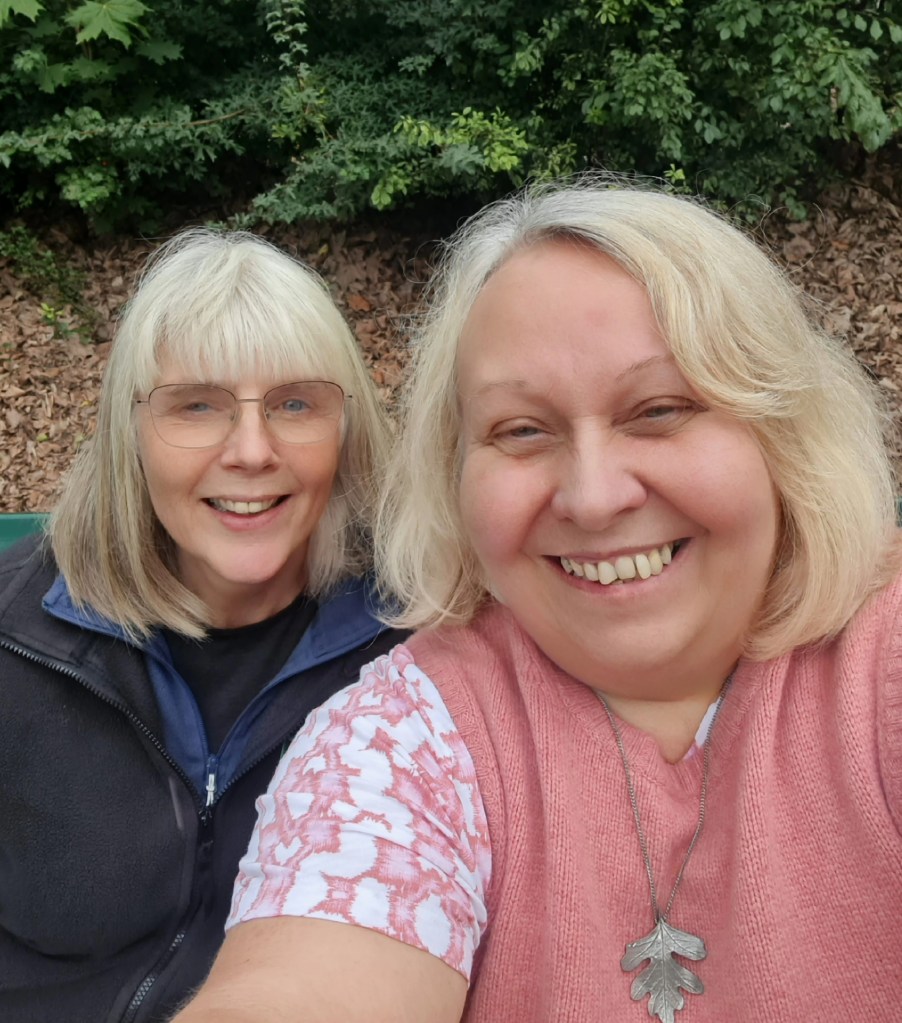
Helen Harvey sitting on a bench in Garrison Lane Park
You can listen into our chat by clicking on the audio link at the bottom of the page. It’s a good one so you may need a hot drink and perhaps a biscuit, you can always walk it off later in the park.
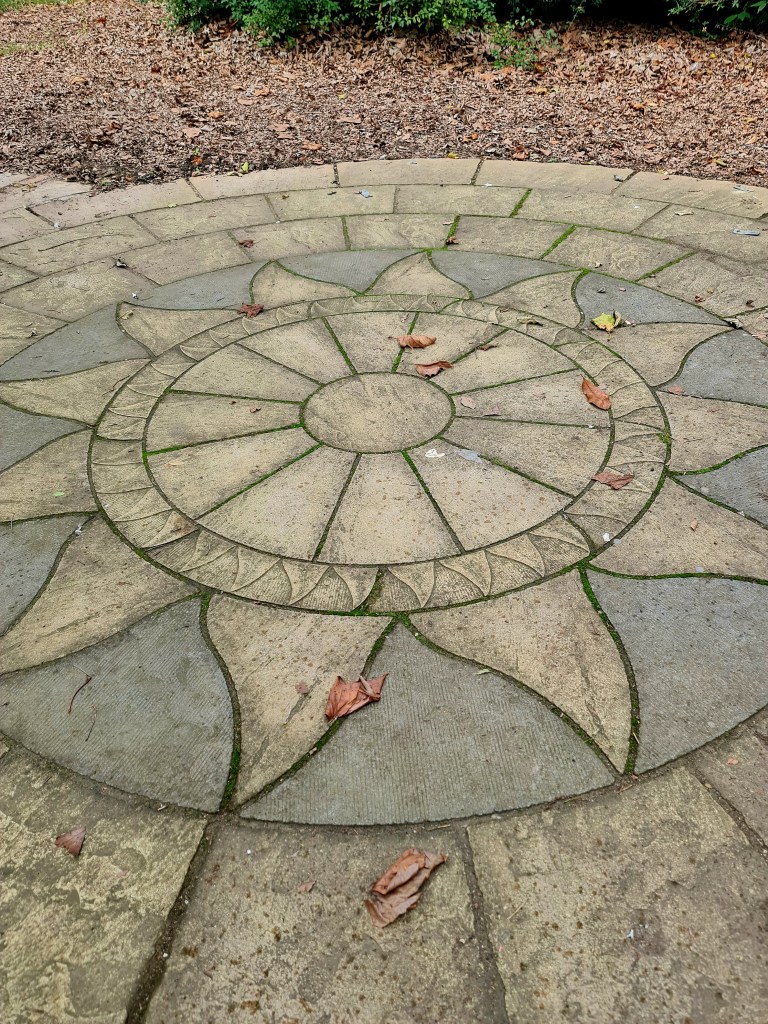
Helen describes Garrison Lane Park and the contemplation area we chose to sit in for our chat. One feature that is easy to miss is a sun shaped design on the floor which as we find out can represent different things to different people.
Helen has been involved with the City of Nature work from the early days of the Future Parks Accelerator Project, helping to bring Dawberry Fields Park to life and then taking on a whole ward (and more) with the Bordesley and Highgate Future Park Standard Pilot and remains connected to nature and parks through her own voluntary work with the Friends Group at Holders Lane Woods and supporting other community projects in Birmingham.
I don’t record every bench chat I have, but I do share the one’s I do record, this one will need you to make a bit of time to listen in to but as always the personal insights, and as Helen says joyful stories, and the laughter make our chat really worth sharing. So you are welcome to join us on a green metal bench in Garrison Lane Park as I ask Helen if she is OK.
If you don’t know me, I’m Debbie Needle the Community Coordinator for the City of Nature Programme and I would love to come and chat with you in your park, please contact me if you would like to share your story. But whatever you do, please visit your park, make time to talk to family, friends and colleagues and remember you don’t need to keep it short, just let the conversation flow and enjoy.
It’s not every day you see a clown getting his blood pressure tested. But at the Nechells Be Healthy Environmental Fun Day in Bloomsbury Park it was just one of the memorable moments I can recall from a lovely event. It was a very warm and sunny day filled with laughter and occasional screams of delight at the “slight of hand” magic tricks that never failed to amaze everyone. The afternoon had been organised by Yvonne from Birmingham Open Spaces Forum https://bosf.org.uk/ to introduce residents in Nechells to a range of opportunities to use green spaces for their health and wellbeing and a great time was had by all those who came to the very well attended event in August.
There were plenty of ways to help people of all ages connect with nature to help improve their physical and mental health. Over 40 children opted to leave the other activities to join the very passionate and knowledgeable Chris Millward Jnr on a bird walk around the park and learn about the history of the land the park now stood on.
The National Trust https://www.nationaltrust.org.uk/ engaged people in thinking about a new pocket park and use paper cups to introduce bulb planting to improve biodiversity and cheer up green spaces. The Canal and Rivers Trust https://canalrivertrust.org.uk/ were there to encourage people to use the canals for exercise – “You are probably closer to a Birmingham canal than you think.”
There were lots of fun games for the children to try including cricket and advice for adults about getting healthy and staying healthy including the daily mile walking route in the park and talking therapies. For me it was another chance to stop and spend some time enjoying Bench Chats https://naturallybirmingham.org/2024/08/16/friendship-bench-chat/ with friends and colleagues.
Although the park does have benches Alex Morton from the National Trust and I chose one of the logs that have been left in the park under the shade of some large trees for our chat. Alex was one of three friends who took some time away from the crowd to sit and chat for a few minutes and you can listen in to our conversation here:
Yvonne Wager,one of the Volunteer Development Officers who work for Birmingham Open Spaces forum, joined me under threes to talk about the success of the Be Healthy Day and think about the mental health benefits of parks and making time to talk about ourselves and the challenges we may face as our lives change. You can listen in to how our conversation covered the business side of connecting people to nature and personal choices that we need to consider as we get older.
Finally my friend Nikolai Attard also from the National Trust talks to me about what he can see from our log bench which he explains includes community, the future and a lack of flowers in the park. It is so lovely to hear the children playing around us and hear Nikolai’s description of the different organisations working together becoming a community. Sharing stories about spaces like canals and parks and what makes us happy. Asking the question are you OK? and listening to the answer. You can listen to the answer here:
“Every breath we take is a symbol of what being connected to nature actually means”. Sitting on a log in park it all becomes a bit philosophical but very wonderful. Talking to Nikolai – always a pleasure.
You can try Bench Chats for yourself – give it a go, it really does make a difference.
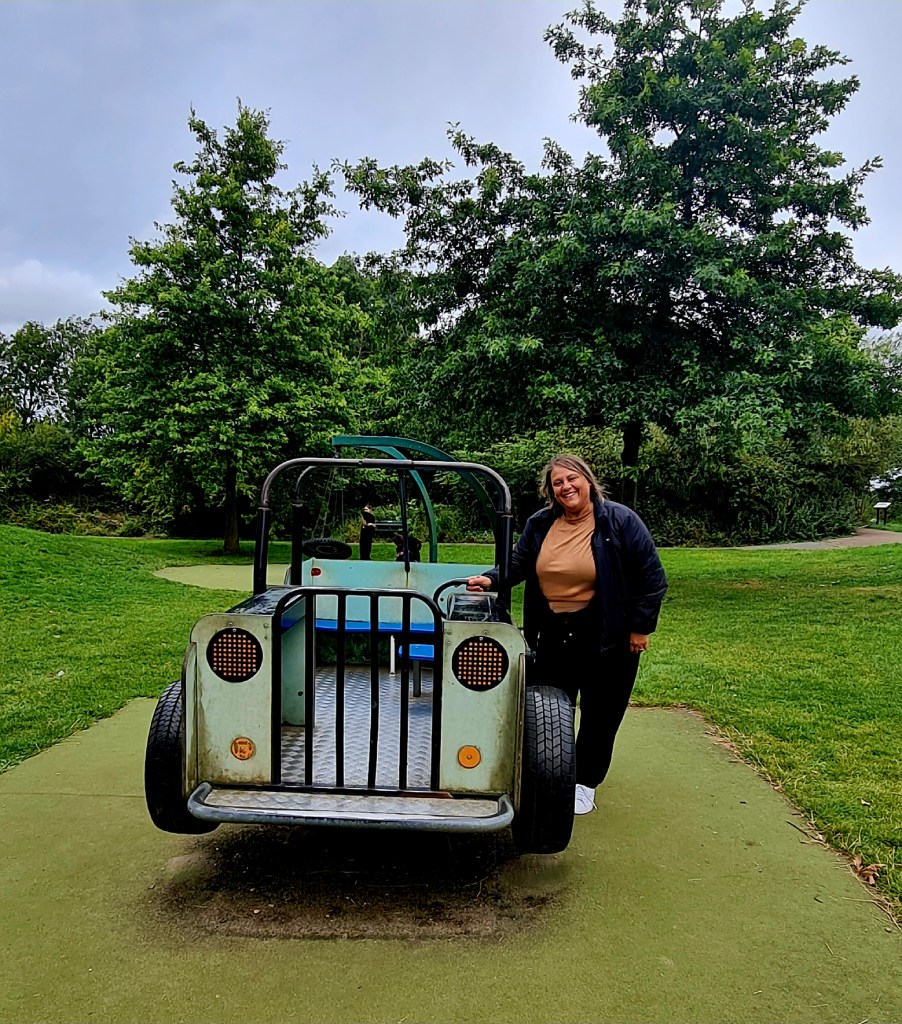
My third Friendship Bench Chat was with Sam a good friend and ex colleague. We met up at Woodgate Valley Country Park on a Thursday lunchtime. It was so good to see Sam as I pulled into the car park, and we were both already smiling as we hugged. It was another overcast and breezy day but there were lots of other people visiting the site and using the relatively small play area. One piece of play equipment that is always in use is the springy Jeep. We asked politely if we could take a picture without the children who kindly stepped aside for a moment but returned immediately we had captured the image.
Sam and the springy Jeep
Just a couple of minutes walk from the main road and carpark it feels like you are in a much more rural countryside setting with woodland and open fields ahead of you. Woodgate Valley Country Park Information
We chose to explore the Green Walking Route (1 mile). We walked past the front of the Visitor Centre (which is sadly still closed) and took the path between the horse meadows, leading down to the stream. You don’t have to go far to “look out for wildlife”, birds and butterflies were immediately visible from the top of the path and the horses in the fields stood quietly contemplated the stream of people walking past them. Swallows flew close to them but they didn’t move much unless it was to shake their manes to remove any annoying flies that landed on their faces.
At the bottom of the fields you can make a left turn following the stream past the Trekking Centre, then straight ahead up Watery Lane. At the main road turn left and briefly walk along the pavement before re-entering Woodgate’s car park.
For those in search of more exercise there are the Yellow and Red Routes and the Illey Way for even more of a challenge: Woodgate Valley Walking Routes
The purpose of our visit this time was to catch up with a Friendship Bench Chat so we chose a bench from the selection of benches around the car park, which include many styles that almost create a story of their own, and settled down on a dark green metal picnic bench for our chat.
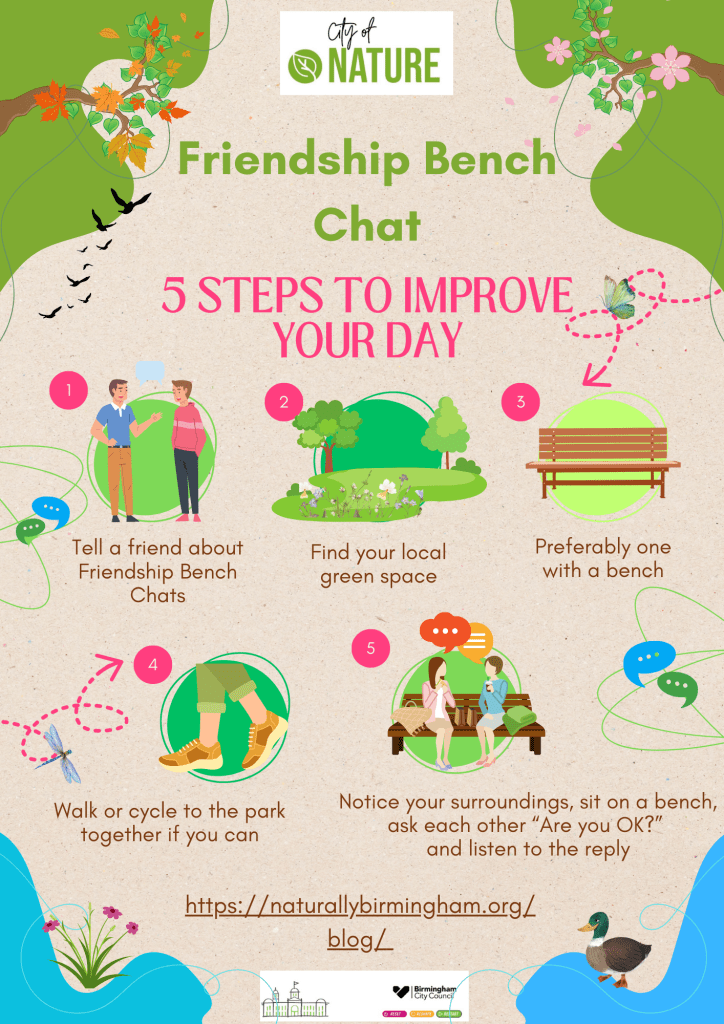
There are only five steps to improving your day through a Friendship Bench Chat (if you listen in to our chat you will have heard I did lose the ability to count to five – never mind).
Sam’s response was a bit quiet when I talked about how being at Woodgate made us feel – but she said there was a warmth to being among other people who were chatting together and to see the children playing. We had already heard the word joyful used and now warmth. You really should try it.
If you would like me to come to meet you for a chat please do get in touch, taking time to notice nature really can improve your day and I would love to hear about your park and find out if it helps you feel OK.
Look out for the next chat which I am planning to be at Garrison Lane Park, hope to connect with you again soon.
My second Friendship Bench Chat was with Humera sitting on a bench on a breezy day in Swanshurst Park (note to self remember to take the furry microphone next time.)
Humera is a Public Health Consultant and lead the Future Parks Accelerator project in Birmingham – The Naturally Birmingham Project and a Friend of Swanshurst Park.
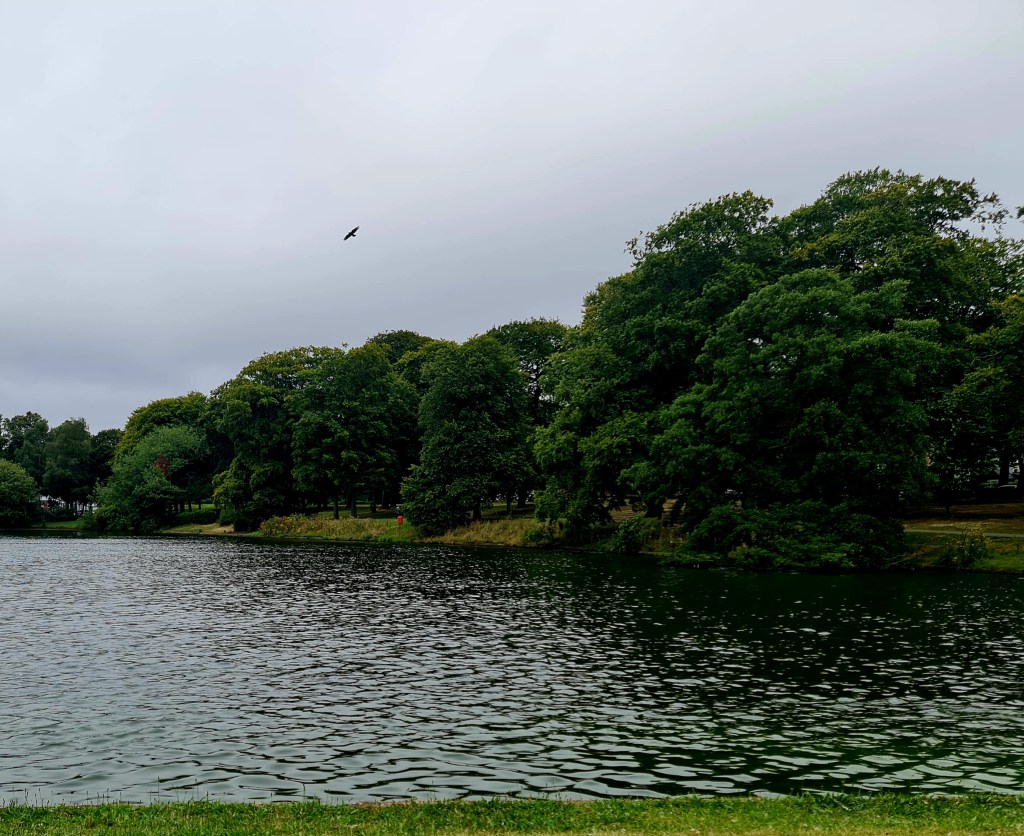
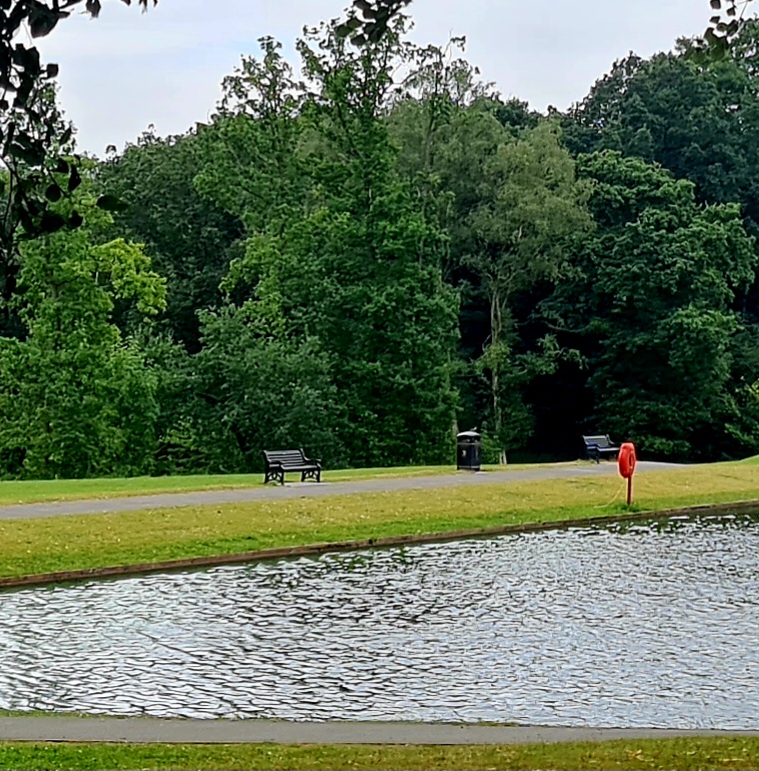
Entering the park at Swanshurst Lane, passing the community noticeboard and heading towards the lake you very quickly find traditional park benches along the lake side, a perfect place to stop and chat about us, nature and parks and ask the question are you OK?
We knew through our Earth Stories project that people often have fond memories of nature and green spaces and also have hopes for the future of them, but don’t always have a chance to share those stories and thoughts.
I stopped Humera for a couple of minutes in her very busy and active day to arrange to meet and sit down together for a chat. Talking and walking is also a brilliant way to keep active and share thoughts with friends and I would encourage you to do that as well and may be walk together to the park. Or as Humera did you can cycle to a green space. But there is something special about stopping to look around you and watch the world go by or as we did spend time focused on each other by simply sharing and listening.
It was overcast with grey clouds but it was dry and we had a view of the lake where ducks and moorhens were going about their business also chatting to each other as they did so.
You can listen in to our conversation where Humera introduces herself and describes her day so far before I ask her if she is OK and we discuss the importance of benches and why we feel getting out and connecting with nature and each other can make our day even better.
With work meetings in the diary we bid each other a fond farewell and both left our bench to return back to our busy days. But as I walked along the road I looked back at the bench and smiled recalling the conversation and laughter and looking forward to our next meet up.
A 10 minute top-up of nature and friendship, it does require a bit of planning, a green space and a bench but it’s really worth it. Why not try it or if this is something you do any way why not share your favourite chatting places with us.
My first Friendship Bench Chat was with the Friends of Perry Park on a sunny Sunday afternoon. One member of the Friends Group is Val and she has been a City of Nature Green Champion from the start of the programme in 2022.
I asked Val if she would like to start off the Friendship Bench Chat conversations in Perry Park and she jumped at the chance but there was a small problem.
At one of the main entrances to the park where the group often start their litter picks there are no benches or around most of the park.
Not put off by this, instead of sitting on a bench chatting we stood in the welcome shade of large lime trees to discuss the good and bad about the parkland, which includes a lake, that wraps around the Alexander Stadium which hosted the Commonwealth Games.
The Stadium is well known but the park is often missed by people visiting the stadium something the Friends Group wants to change. They believe if more people knew what the park had to offer their group would grow in number and more people would come and use the park.
The park was used to support the highly successful Commonwealth Games that was enjoyed by thousands of people living in and visiting the city, but it is time now for the park to benefit from the success of the games and be returned not only to it pre games state but also enhanced for the use of all park visitors. Those enhancements would include benches so Val doesn’t have to prop herself on the table tennis table to take a rest while walking round the park as part of her recovery from a recent accident.
The City of Nature Plan includes a standard for Parks and Green Spaces call the Future Park Standard. The concept behind the standard is if we were to build a brand new park what would it need to have, what would be the minimum acceptable standard for that park and what would make it a good park, which would be Green Flag Standard https://www.greenflagaward.org/about-the-award/what-is-the-green-flag-award/
We retrospectively apply that standard to existing parks using any funding we have available to ensure that all parks are raised to the same standard of any future parks that may be built. This is not a quick process and it needs everyone working together to achieve it, but together we will be able to do it.
The group also wants to ensure that children can use the park for playing and although having the park on their doorstep is very beneficial being able to access good quality play equipment encourages families to get out into their green spaces and then explore further.
There was lots of wildlife using the park when I visited, the birds were singing around us and we could see butterflies fluttering around the long grass behind the carpark. But the Friends Group wants to see the park offer more for residents and people using the stadium. Being able to use the whole park for exercise and also to be able to stop to notice nature and chat making sure that as many people as possible can benefit from this wonderful city asset.
Sometimes the simple ideas are the best. The Friendship Bench Chat started out as a conversation about benches and ended up being about talking to friends, sitting on a bench, outside of course.
Having encountered a problem getting a bench installed in a Birmingham park the City of Nature Green Champions discussed the importance of park benches and some of the issues that can come with them. Basically – are they worth the cost and the effort?
To answer this we need to ask “Why do we need benches?” It’s no surprise to find we aren’t the first people to ask this question or to try to answer it. A quick internet search shows that the importance of benches is well understood and documented. The aptly named “Bench Project” even resulted in a bench manifesto: https://the-bench-project.weebly.com/manifesto.html
One obvious point in the manifesto is: “Sitting on benches supports healthy everyday routines by enabling people to spend longer outside. These opportunities to rest can be restorative for mental health and support local walking when personal mobility is limited.”
In our discussion the idea of school Friendship Benches or Buddy Benches came up. A Buddy Bench is a place on playgrounds for pupils to sit if they are lonely or have no one to play with. When other children see someone on the bench, it is an indication that the child is looking for a friend and should be asked by someone to join in the school-time fun.
The Friendship Bench is a Non-Governmental Organization (NGO) registered in Zimbabwe. Their visionis a Friendship Bench within walking distance for all. With this inspiration, their mission is to get people out of “kufungisisa” – depression & anxiety – by creating safe spaces and a sense of belonging in communities to improve mental wellbeing and enhance quality of life.
Agreeing that benches are a very important social tool for health and wellbeing, we wanted to get people talking about benches and supporting them as an important part of park infrastructure. So the idea of the “Friendship Bench Chat” was born. To start with it was going to be chatting about friendship benches, but it quickly became friends sitting on a bench chatting, but either of these are a great idea and you can do both as we find out when we started going out to meet people for a Friendship Bench Chat.
There are just five steps to a Friendship Bench Chat so why not give it a go and share your experience with us, we would love to see photos as well.
You can find out more about Birmingham’s Nature Recovery Network, the development of A to Bee Roads, and why we need to start changing the management of amenity mown areas to support nature recovery in urban areas by watching the recording of the presentation given to the Green Champions who joined us for an online chat on the 14th June: https://youtu.be/gPDDVg1WtWE
You can also see a copy of the slides from the presentation here:
General Practice Registrar – Public Health shares her story about discovering her local park
It is said that interacting with nature can do wonders for our mental and physical health – something that I didn’t quite appreciate until recently. Sitting one afternoon in my GP office, with the rain and sound of thunder in the background, I sat flicking through the patients coming in that afternoon. Wondering about the sorts of cases I may be faced with, I ran through hypothetical scenarios and how I would manage these in my head. Detached from my physical surroundings, I was quickly brought back to the present by another loud clap of thunder. Startled, looking out of my office window, I remember thinking to myself ‘wait…has that park always been there…?’
Having worked at the GP practice for one and a half months, and having been so preoccupied with my work, I had never taken the time to register the nature in my surroundings.
The next day, I made a point to go for a lunchtime walk. Finishing up my morning clinic, I walked over to the back of the carpark and decided to explore. Thirty minutes later, I had discovered three different parks near the GP practice. From a park with a woodlands section, to another with a children’s play area, I was pleasantly surprised to note the facilities available in the local community.
The following day, I decided to take a colleague with me. What started as an almost incidental finding, soon progressed into a daily habit. Completing our morning clinics, we would go for our lunchtime walks; this not only gave us the chance to stretch our legs, but also gave us a mental break from staring at our screens. We found ourselves returning to our afternoon clinics refreshed and ready to go.
A couple of weeks later, discussing health and fitness with a patient, I found myself recommending the local parks for a quick morning stroll. With a greater awareness of our local resources, I was able to confidently advise using nature as a way of becoming physically active. Taking a moment, I noted the significance of the situation; by taking the time to explore, and thus improving my mental and physical wellbeing, I had inadvertently gained a tool to be able to offer the same to my patients.
Often working in a busy GP practice, we can get lost in the world of medicine. This can lead to us forgetting to take a break and a moment for ourselves. By introducing this new habit, my colleague and I noted improvements in our moods, mental welfare and not to forget fitness. This experience taught me the importance of taking a second to appreciate our surroundings – something I will carry forward when I move onto my next GP Practice.
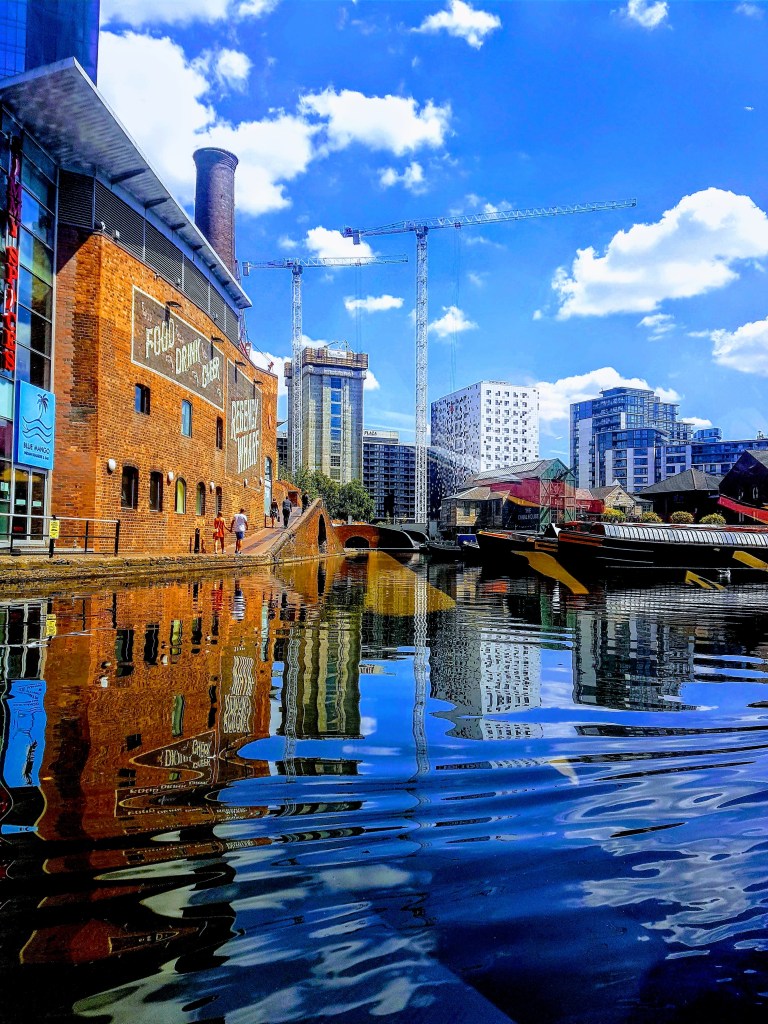
A view of Birmingham’s canals and buildings from the water
The people who are making spaces for nature in Birmingham
I am the Community Facilitator for the Future Parks Accelerator Project and I set out last Saturday morning with my bag packed full of the weighty plans, policies and processes that Birmingham City Council and its partners are working on now and for the next 25 years. My aim was to facilitate a community session at the Birmingham Open Spaces Forum Conference being held at the University of Birmingham’s Exchange Building, https://conferences.bham.ac.uk/venues/the-exchange/?cn-reloaded=1 I was looking forward to the chance to talk about Nature Recovery Network plans and the benefits of Biodiversity NetGain, oh yes! Now, those topics may excite you or turn you off, people’s interests differ massively, even people who have come to the same conference and chosen the same session to join, that is what makes life so interesting and joyful. But I was hoping what I had to say would excite people and encourage them to get more involved.
Arriving in Centenary square in the sunshine, it was strangely quite no trams or busses in sight and not many people around. The emptiness made the noise of the wheels of my wheelie bag echo loudly bouncing of the Birmingham Library and making the few people who were around turn in my direction to see what was rattling through and disturbing the peace. I made it across to the Exchange and was greeted by two people with smiling facing who were “there to look after me”, how lovely. Out of the lift I was greeted by the BOSF team, commenting on my leafy blouse and getting me a cup of tea, I really did feel welcomed and as the people on the table I selected to sit at greeted me with more smiles it just became an even more wonderful day to be back with everyone again – it seemed to have been such a long time since the last in person conference.
We were treated to a morning of informative presentations provided by keynotes speakers which included battling fly tipping and new initiatives to help people recycle larger items, helping geography and earth science students experience real life environmental issues. (I was lucky when I studied for my earth science degree, I was already working in BCC Parks growing bedding plants in the two main Council owned nurseries in Birmingham, happy days). We were treated to a round of “Just a Minute” sessions where people provided updates about their parks and groups, shared successes and problems and received applause for their ability to sum up the situation in just 60 seconds! And encouraged to use a seed corn fund to “grow” more money for community projects in parks.
Then too soon it was time for lunch, mine was egg mayo sandwiches and Dutch apple cake followed by fresh fruit salad, really tasty. Great conversations about so many different subjects filled the room with noisy chatter and laughter and then it was time for walks and talks to start. My group manoeuvred their chairs into a large circle, and for a moment we were quiet in the sunshine as they waited for me to start. I handed each participant a copy of the City of Nature – a 25-year plan laid out in a book which includes colourful pictures of Brum and its green spaces, people and wildlife and sprinkled with “Earth Stories” each one explaining how the storyteller was connected to nature, what it meant to them, why it was important and, in some cases, vital to their good health: https://naturallybirmingham.org/birmingham-city-of-nature-delivery-framework/
As I took my seat and looked around the group, I realised that here in front of me was the City of Nature and each person had a part of the plan and a part of the story. Someone commented that there was no “top” position in the circle, and the Forest School leader in me suddenly felt that something very special could happen here. I invited the group, with their permission, to share their stories with each other and so they unfolded. Tales of tiny but magical woods taken back into the city’s care, how growing together, tackling the litter and gardening was bringing people together, communities working to turn “abandoned” areas into family friendly spaces. Finding special places full of dragonflies, kingfishers and newts sadly making their homes between the rubbish, fishing line and other discarded things but getting on with it anyway and then rallying people to help clean it up and give nature a helping hand. Battling for a grass verge against illegal parking or taking on the work of a caring for a large and wonderful woodland. Using creativity to open up nature to more people, through art and performance, leading walks in urban spaces but noticing nature everywhere. Opening up access for school children to a green space where nature was on their doorstep but never visited. Planting thousands of trees with thousands of people and taking on the challenge to help teach others how to care for them. Sharing the pure sensory joy that the sights and smells a warm greenhouse provides, loving the freedom to coddiwomple (purposefully wander) or stop and try Shinrin-Yoku, bathing in the peace and energy a forest provides and teaching other people skills that may otherwise be lost. Keeping going no matter what, dealing vandals who don’t care and deer who only see nature as their harvest not ours and finally the importance of caring for tools others will use to care for nature, sharpening the shears and cleaning the spades – to the surprise of many. The circle was closed, and the stories were told, and we had been on a journey across the city and through time. How marvellous. Here was the City of Nature, here were the people who were making space for nature in Birmingham. Contacts made, numbers swapped, re energised and inspired the circle dissolved and we returned to our starting place.
There is so much good happening in so many places, but there is still so much to do. So not the end but the beginning. I still have all the plans and policies and processes, and I am sharing some of them here: https://naturallybirmingham.org/nature-recovery-for-birmingham/ for those of you that like those things. But you can also get even more involved and find out more by joining me and other Green Champions for our Nature Natters Sessions online (mostly) but sometimes out with nature, wherever we can find it. You can use the contact us form below to sign up to receive more information and updates about Nature Recovery in Birmingham. Please do join us I am looking forward to hearing many more of your Earth Stories and sharing with you the plans for making the whole of Birmingham a City of Nature.
Thank you to the BOSF team for a lovely day, well done.
Debbie Needle – Community Facilitator Urban Nature Development Programme











 Naturally Birmingham Future Parks Project