We want every Birmingham City Council park to be maintained and used to a Fair Standard. By this we mean achieve at least a “Fair” score in the Birmingham Future Park Standard audit. We also want to increase capability in communities so they can help their local park achieve a “Good” or above score which is the standard of a park that could achieve a Green Flag Award: https://www.greenflagaward.org/how-it-works/judging-criteria/green-flag-award/
Here are three videos that help to explain the Birmingham Future Park Standard process:
The general aims of applying the future park process are:
- To ensure that everybody has access to green and other open spaces of a fair standard, irrespective of where they live.
- To ensure that these spaces are appropriately managed and meet the needs of the communities that they serve.
- To establish standards of good management, and to promote and share best practice amongst the green space community.
- To recognise and celebrate managers, staff, and volunteers and people who use the park well.
Each park will have elements assessed against a standard under the five City of Nature themes:
• Fair – is it welcoming, accessible, clean, and safe?
• Green – are there different trees and plants, are there habitats for wildlife, is it managed sustainably?
• Healthy – are there walking routes, quiet areas, activities, is the park used for social prescriptions; and play value?
• Involved – can you find out what’s happening in your park, can you influence what is happening?
• Valued – do we know the worth of what the park provides, is that shared, are there ways to raise extra funds?
When a park is assessed, if it doesn’t meet the Fair score of the Future Parks Standard a priority action plan will be created to detail out what can be done to raise the park to this standard. This approach will set a new benchmark of quality for all Birmingham City Council parks. Over the course of this 25-year period all parks will be assessed against the Birmingham Future Parks Standard and management plans will be created.
Where are we starting
In a city with around 600 green sites managed by Birmingham City Council, where do we start this process?
Developed through the Naturally Birmingham Future Parks Accelerator Project, the 25-year City of Nature Plan (2022) is changing the way Birmingham treats its natural environment and how it thinks about the future of its parks and green spaces. We looked at how other cities around the world have responded to the issue of unequal access to green space; and from this research and collaboration Birmingham became the first UK local authority to develop a measurement tool for environmental justice.
Environmental justice is defined as: the fair treatment and meaningful involvement of all people regardless of race, colour, national origin, or income, with respect to the development, implementation and enforcement of environmental laws, regulations, and policies.
We developed an environmental justice map of the city that shows where in the city compound issues are being felt most. This presented a real challenge to the city, how do we level this up? Over the course of the 25-year delivery plan, the Birmingham Future Parks Standard will be applied to all parks, ensuring all those falling below the threshold are brought up to that standard; starting with those wards with the highest score for environmental injustice, ensuring BCC’s network of parks all achieve at least the fair standard by 2047.
From 2022 to 2027, Birmingham City Council has secured funding to focus efforts on the following 6 wards –
- Bordesley and Highgate Ward
- Balsall Heath West Ward
- Nechells Ward
- Gravelly Hill Ward
- Pype Hayes Ward
- Castle Vale Ward
You can read about the Bordesley and Highgate Future Parks Pilot project here: https://naturallybirmingham.org/city-of-nature-pilot-project/
However, we will work with all wards in the city to provide support on how they can do more to support their green spaces.
Bordesley and Highgate Ward
Here is an example of where we are applying the Future Park Standard process. Below is an artists impression of improvements being delivered in Highgate Park to raise the standard of this park from Poor, which is 4 on a scale of 1 – 10 to Fair which is 5 – 6.
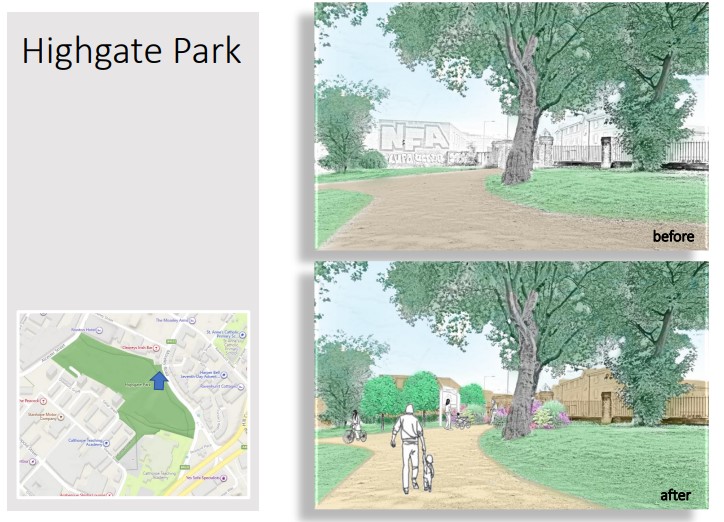
You can see that improvements included new trees to screen older buildings, increase tree canopy cover and increase biodiversity. New planting of shrubs to provide colour and interest and also increase biodiversity. A noticeboard to be able to tell people what is happening in the park, new litter bins and if needed new benches.
To improve the Healthy Park part of the score mile long walks and walking routes have been marked out in some parks including Highgate Park:
You can see Green Champion Volunteers visiting another Bordesley and Highgate park – Kingston Hill Local Park here:
Background
The Association for Public Service Excellence (APSE) published a report in 2021 – The State of UK Parks 2021. The key findings were that parks budgets in the main continue to be cut, with an estimated £190 million being lost from UK local authority parks budgets over the last 5 years. Worryingly, the study has shown that the current condition of UK parks is at its lowest point since the 2014 survey, with the proportion of parks in good condition being lower than those in a fair condition. Read the full report here: https://www.apse.org.uk/apse/index.cfm/research/current-research-programme/state-of-uk-public-parks-2021/
Most public services have nationally published and monitored minimum standards; Parks are unusual as they have never had these.
The intention of the Future Parks Standard is to get all parks to the ‘entry’ level requirement for Green Flag as a proxy for a national minimum standard. This level is described as scoring as “Fair”
This can be used to assess every park and green space, as opposed to the Green Flag Award which is an award of a good standard and is normally only used to assess parks that would be considered to be a standard already high enough to achieve a Green Flag award. The way we use the criteria is to ensure all paths are considered against this standard and plans are made for improvement.
Developing a How to Guide or Handbook
We are developing a guide to help Future Park Standard assessors, whether those are parks professionals or communities, to be able to apply this method.
It will outline the process required to undertake a Future Park Standard audit which includes considering the context of the site involving certain desktop studies or data sets in addition to an onsite audit.
The approach taken does mirror that of the Green Flag Award, as that method is widely understood and accepted as a norm across the UK and internationally, therefore the Band Scores align with the Green Flag Award, but each criteria is looked at separately and scores are not added up. This is more inline with Hotels that have to achieve a certain standard across all criteria.
The field or onsite audit must be informed by the site’s wider context with a key focus on community capacity and engagement.
The Green Flag scoring bands are as below:
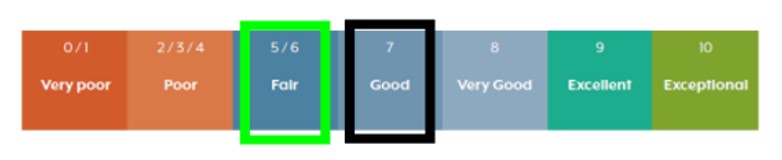
We want all parks to score as at least “Fair” when we audit. To meet this standard all elements, must meet a minimum score of 5 out of 10, with 0/1 being very poor and 10 being exceptional.
Please Note: The Future Park Standard audit will also make recommendations of how the site can reach the “Good” or Green Flag Standard with additional resource. For sites that are scoring as “Good” then recommendations for reaching “Very Good” would be made and so on.
There are currently 22 criteria which the site is audited against, which sit under five City of Nature Themes.
A Fair Park
A fair park is a welcoming place. It is one that invites and draws people into it – it creates a good first impression.
This means creating a space which, through its visual appearance, range of facilities, standards of maintenance and ease of access, makes people feel that they are entering a cared-for place which is in turn reflected in the greater enjoyment of, and respect for, the park.
A Fair Park should:
- Feel welcoming.
- Have good access to site.
- Have good and appropriate signage.
- Have equality of access to facilities.
A Healthy Park
For a park to provide public health benefits both physical and mental health, the site needs to not only provide opportunities for healthy activities but also be safe and secure, so people feel confident and able to use the facilities and activities provided.
A Healthy Park should:
- Provide facilities and activities (appropriate to site).
- Have equipment and facilities that are safe.
- Be managed to provide personal security.
- Control of dogs and dog fouling.
A Green Park
This section covers a wide range of criteria including biodiversity, waste management, horticultural management, tree management. We know from consultation that if a park isn’t seen as clean and well managed then wilder more natural and biodiverse areas are often seen as unmanaged. We want parks to be place for nature recovery and spaces for wildlife to thrive so we need to make sure the balance between management and wildness is maintained.
A Green Park should:
- Show good waste management, including litter.
- Show good horticultural management of grass, shrubs, flower beds etc.
- Show good tree management.
- Show good maintenance of structures.
- Show good maintenance of equipment used by public (where relevant).
- Show good management of natural features.
- Show good diversity of species of plants.
- Show good provision of habitats for appropriate animal species.
- Provide wetland / water features where appropriate.
An Involved Park
This criterion serves to verify that the provision of facilities, services and events is suitable for the whole range of users and potential users – within the limitations of the site.
We look for evidence of appropriate provision of facilities and activities. The existing facilities, activities and events on site are evaluated to ensure that they allow users to lead healthy lifestyles, and to be personally safe and secure.
Research shows that people visit green spaces for different reasons – some for adventure and challenge, some seeking peace and solitude and a spiritual connection to nature, others for family activity and the recreational needs of their children, and yet others for social activity, sports and fun with friendship groups. Age, gender, culture, ethnicity, and social and personal circumstances also play a part in shaping these needs.
Recognising that every site will have its limitations, managers should seek to understand this diverse range of needs, and where possible, to provide suitable facilities and related activities. The part that this site plays in any district-wide or local plan for varied provision should be detailed in the management plan. Limiting facilities to maintain a particular site’s characteristics is just as valid. For example, a nature reserve protecting sensitive ecosystems or species may aim to keep visitor numbers low, so they might aim to keep on-site facilities to a minimum.
There is no predetermined list of expectations depending on the ‘type’ of site – it is important to respond to the needs of users. It is also important to feed back to users what can and cannot be provided and the reason behind the decision.
A Valued Park
Natural spaces provide what are known as Eco System Services and Natural Capital. The term natural capital refers to the elements of the natural environment that provide valuable goods and services to society. It applies an economic lens to the world’s stocks of natural assets — like forests, rivers, and soil — and how society and businesses rely on them to function. Think clean air and water, medicine and food, temperature, and weather regulation. Even small sites in an urban setting offer important services.
Understanding both the financial value and cost of these services is what “Valued” is all about.
 Naturally Birmingham Future Parks Project